
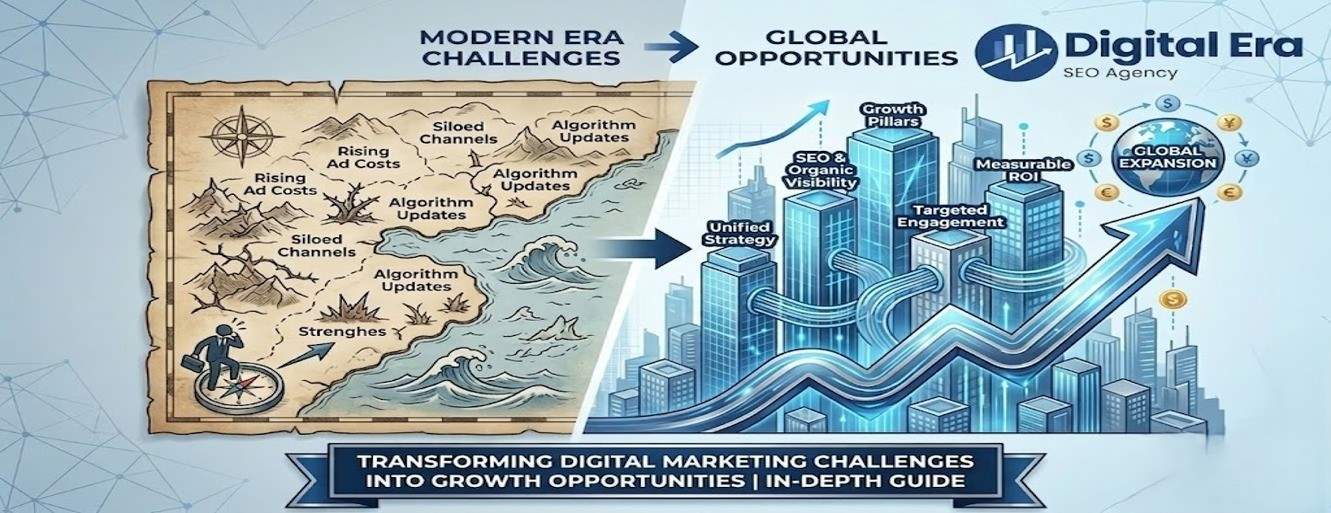
Top Digital Marketing and Business Challenges in the Modern Era
Table of Contents
In today’s rapidly evolving digital landscape, businesses face multiple digital marketing and business challenges in the modern era that directly impact online visibility, lead generation, ROI, customer reach, and cost per acquisition (CPA). Frequent search engine algorithm updates, rising paid advertising costs, increasing competition, and strict data privacy regulations have made digital marketing more complex than ever.
Many organizations struggle with critical digital marketing challenges such as identifying the right target audience, creating high-quality content that ranks on search engines, managing multi-channel campaigns, and achieving measurable marketing results. Keeping pace with SEO changes, audience behavior shifts, and performance tracking adds further pressure on businesses.
At the same time, new opportunities are emerging through data-driven marketing, AI-powered automation, advanced SEO strategies, and omnichannel customer engagement. The key challenge lies in understanding how to turn these digital marketing challenges into sustainable growth opportunities.
In this guide by Digital Era SEO, we explore the most important digital marketing and business challenges businesses face today, explain why they matter, and provide practical strategies to overcome them and build long-term competitive advantage.
Foundation-Level Challenges
Foundation-level challenges are issues that severely impact digital marketing performance.
When left unresolved, they prevent businesses from achieving desired goals efficiently. When these challenges and issues are not addressed professionally, even advanced marketing tools, data-driven platforms, consistent insights, advanced strategies, and campaigns fail to deliver sustainable results.
Such core issues or problems mostly stem from weak and unclear strategies, inconsistent execution, resource scarcity, lack of research, and misalignment between business goals and digital marketing development.
A comprehensive understanding of these issues is the first step toward establishing a resilient digital marketing framework. By detecting and categorizing root causes initially, businesses can circumvent costly mistakes, attain optimal decision-making, and establish a strong foundation for scalable success and growth across business digital marketing goals.
Such goals could pertain to:
- SEO
- content marketing,
- social media marketing,
- paid marketing,
- email marketing.
Digital Marketing Challenges and Opportunities for Businesses
Businesses today operate in a complex digital marketing environment where tangible challenges and measurable results coexist. Key challenges include:
- Rising customer acquisition costs.
- Visibility and search competition.
- Algorithm updates.
- Data privacy regulations (limiting third-party tracking).
- Complexity in attributing conversion.
- Smarter budget allocation
- Technological changes
- Fragmented marketing.
Businesses that adopt a strategic, data-driven approach can unlock powerful opportunities. Such opportunities could be
- Invest in SEO
- First-party data
- High-intent content
- Advanced analytics and automation
- Consulting proven experts and agencies
- Precise audience targeting
Brands that align content, search, and user experience around real customer needs can strengthen authority, increase trust, and drive compounding organic growth. In this environment, companies that prioritize strategy over tactics can convert digital complexity into a durable competitive advantage.
Digital Marketing Strategy Alignment
Digital marketing strategy alignment starts with clearly defined business goals, precise audience search, and realistic assessment and deployment of internal business capabilities and resources. Ensure that all marketing efforts are rightly connected to core business objectives to bring measurable performance results.
All marketing channels, content development, message production, and budgets must be aligned to support goals. Executing tactics in isolation is most challenging; SEO, paid marketing, content marketing, and social media marketing should have a unified strategic goal.
Digital marketing strategy alignment also requires consistency, such as brand visibility, lead generation, customer acquisition, or revenue growth, ensuring that users experience a seamless journey from search and content to conversion and retention.
For long-term success and an SEO perspective, strategy alignment is essential. Search visibility, content relevance, and user experience must support both algorithmic requirements and real user intent.
Companies that integrate SEO, content planning, analytics, and conversion optimization can uncover performance shortcomings, minimize unnecessary expenses, and engage in data-informed decision-making that accumulates over time.
In the end, organizations that emphasize cohesive strategy rather than disjointed execution are more capable of expanding, adjusting to market fluctuations, and establishing long-lasting digital competitive benefits.
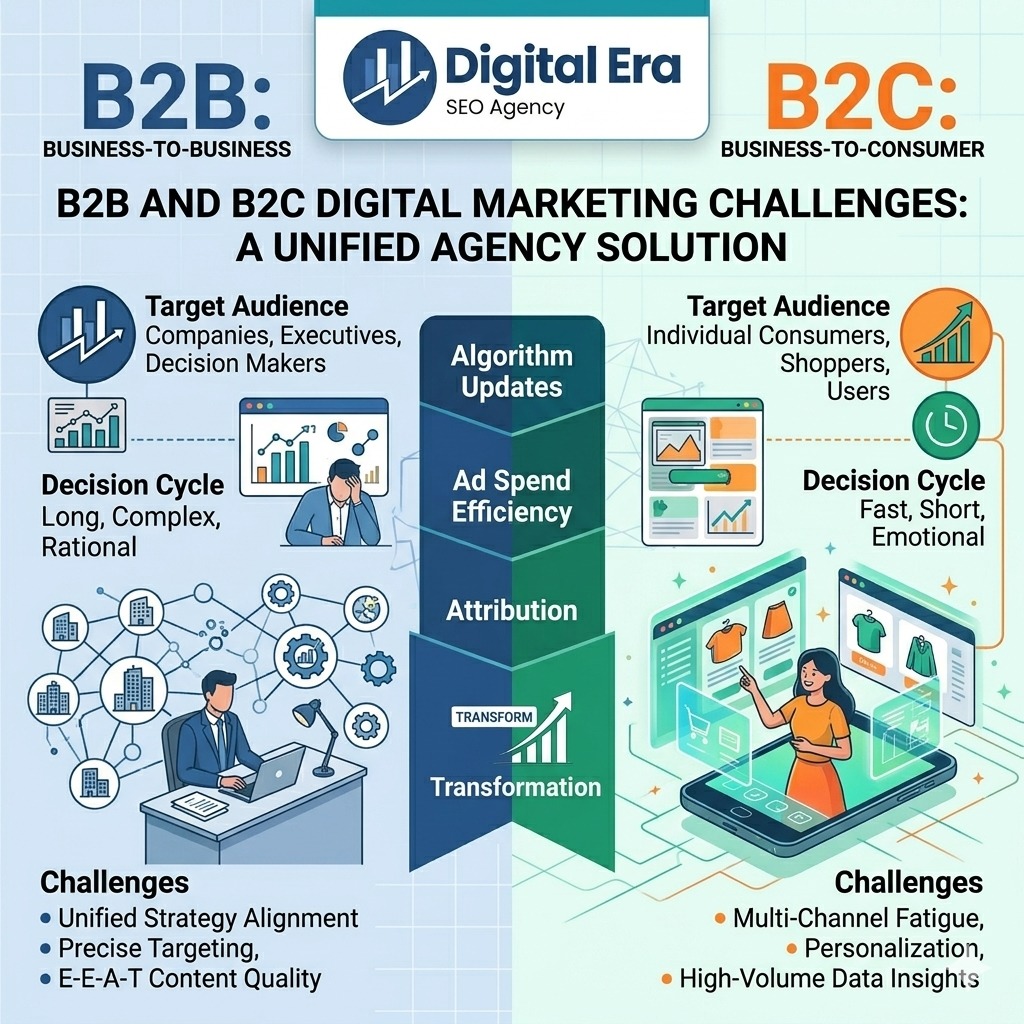
Target Audience Challenge
The target audience challenge stems from inaccurate or incomplete audience personas based on assumptions rather than research and data. It is one of the most critical foundation-level issues in digital marketing.
It is very critical that every business accurately identify, segment, and understand their ideal customers. Poor understanding of search intent across different buyer journey stages, which leads to wasted marketing spend, low engagement, poor conversion rates, and inconsistent ROI.
Overly broad targeting that attracts low-intent and irrelevant traffic, which leads to wasted marketing spend, low engagement, poor conversion rates, and inconsistent ROI. Working on assumptions, outdated data, or overly broad demographics often results in messaging that fails to resonate with real user needs and search intent.
Overcoming the target audience challenge requires:
- Data-driven approach
- Behavioral insights,
- Intent-based research.
- Precise targeting audience segmentation
- Understanding of search intent
- Alignment between keywords, content topics, and actual customer needs
- Cross-channel targeting consistency
- Ongoing testing and optimization
By combining SEO insights, analytics, customer journey mapping, and ongoing performance analysis, organizations can improve targeting accuracy, provide personalized experiences, and draw in high-intent users. Companies that tackle this challenge successfully achieve better engagement, higher conversion rates, and a lasting edge in a crowded digital landscape.
When these issues are not addressed, businesses experience reduced search relevance, inefficient spending, and weak conversion performance.
The core types of SEO necessary for building SEO skills are:
Execution & Channel Challenges
Execution and channel challenges occur when digital marketing strategies fail to translate into scalable and optimal-performing results across all targeted platforms. One of the most common execution challenges is fragmented channel management. Inconsistent implementation weakens brand messaging, reduces efficiency, and limits the ability to scale performance of strategies.
While businesses invest in paid marketing, SEO, content marketing, email marketing, and social media marketing, poor execution results in duplicated efforts, misaligned messaging, and inefficient budget allocation.
Teams frequently operate SEO, paid media, social media, and content independently; channel fragmentation makes it difficult to maintain consistency across the digital marketing and accurately measure cross-channel performance.
Staying updated on frequent platform policy updates, algorithm evolution, and changing strategies; lack of coordination; and channel silos are the common hindrances to achieving high-performing results.
Most of the organizations struggle to sustain themselves with limited resources and a lack of expertise.
While using a website, users interact with the content of the web page, the design, and the graphics. Users experience the website’s niche through its title, meta description, page heading structure, and URL structure. Search engines interact deeply with those websites that are optimally built in the context of the aforementioned elements.

Channel-specific challenges are indicated by:
- Increasing cost-per-click,
- Reduced engagement rates,
- Difficulty in selecting the right channels as per strategy
- Declining visitor traffic and CTR
- Low conversion ratio
- High bounce rate
- Low ROI
Poor execution further compounds these issues, leading to missed opportunities, weak ROI, and unreliable performance data.
Overcoming execution and channel challenges needs a unified and performance-driven approach. Businesses should prioritize channel selection with strategic marketing goals, audience intent, and scalable KPIs.
Integrating all strategies, insights optimization, analytics, and conversion tracking enables organizations to implement campaigns cohesively, optimize in real time, and massively improve channel efficiencies.
Companies that align master execution across channels meet stronger visibility, improved customer engagement, and sustainable digital growth in a cutthroat competitive landscape.
Make sure by all means execution must be governed by unified strategy, data, and accountability; digital marketing channels shift from resource depletion to scalable growth engines.
Without proper keyword research, even well-optimized websites struggle to rank because they target the wrong audience, wrong intent, or wrong search queries.
Keyword research involves:
- Discovering relevant search terms
- Understanding user intent related to those terms
- Evaluating search volume and competition level
- Mapping keywords to appropriate content pages
In simple words, keyword research answers three critical questions:
- What are users searching for?
- Why are they searching for it?
- How difficult is it to rank for that query on search engines?
Effective keyword research ensures your content aligns with real search demand rather than assumptions.
Content Quality Challenge
Content is king in digital marketing. Unless quality content succeeds, digital marketing strategy is clueless. Content quality has been one of the most persistent and impactful challenges. Content must be focused on users’ intent, algorithmic expectations, and platform policies and strictly comply with performance metrics.
Content always outperforms on search engines and digital platforms that demonstrate Experience, Expertise, Authoritativeness, and Trustworthiness (E-E-A-T).
- Informational Intent
Users are searching for knowledge, answers, guidance, or research.
Examples:
- “What is SEO?”
- “How does technical SEO work?”
- “SEO beginner guide”
Best content format:
- Blog posts
- Guides
- Tutorials
- Educational and informational articles
Content quality challenges typically arise from:
Plagiarized or duplicated content that fails to address real audience needs
Misalignment between search and buyer intent, semantic quality.
Weak content structuring, poor readability, or generic messaging
Weak E-E-A-T signaling
Lacking topic depth or misplaced semantic coverage
Unoptimized and poor keyword placement
Poor content quality increases bounce rates, weakens search visibility, dilutes audience engagement, and reduces conversion performance—regardless of channel investment.
Content in any form, text, or visual. Audio, infographics, press releases, copywriting, and AI- and automation-based content must be informative, comprehensive, engaging, and unique. Content must be created with clear, measurable objectives focused on achieving goals such as ROI, conversion rate, user engagement, scalability, CTA, and CRO for scalability.
Addressing these challenges requires an integrated approach that aligns content creation with audience insights, keyword intent mapping, semantic SEO, and performance analytics.
For example, Meta’s latest Andromeda pertains to ads ranking organically depending upon the aforementioned content features. It has shifted targeting toward signal-based optimization using user experience and content signals rather than traditional interest/demographic targeting.
Cross-channel alignment must be Ensured content used in all strategies matched landing page messaging, SEO content, and overall brand image to reduce friction and improve conversion consistency.
High-quality content is considered an asset only when it is aligned for both organic visibility and paid performance. When content genuinely meets user needs, adheres to platform standards, and matches audience insights, it generates improved search rankings, higher paid ad performance, and scalable business outcomes.
Social media and platform dependency challenge:
Social media offers significant growth opportunities, but it also carries inherent risks that businesses cannot afford to overlook. A digital marketing strategy should be developed for diverse social media platform focuses for risk mitigation.
Excessive dependency on any single platform introduces significant strategic risk. Relying heavily on a single platform—such as social networks, marketplaces, or other third-party ecosystems—exposes businesses to volatility driven by frequent algorithm updates, policy changes, rising advertising costs, and shifting platform priorities.
Unlike owned digital assets, social media platforms operate on rented attention. Businesses do not control the volatility of these platforms that control algorithms, audience access, data ownership, or distribution rules. A single update of change can massively shift organic visibility, account restrictions, ad insights, or monetization returns and disrupt traffic, engagement, and content requirements.
Platform dependency risks commonly arise from:
- Over-reliance on a single platform for optimized results
- Declining organic reach as a result of frequent algorithm updates
- Cost-intensive paid advertising and ROI control.
- Limited access to first-party data and audience insights
- Inconsistent performance caused by platform-specific audience limitations
- Weak integration between social platforms and owned assets
- Misalignment between business objectives and the selected social media platform
Mitigating the platform for dependency risk requires diversified platform consideration. Businesses must prioritize building owned digital assets, strengthening organic search visibility, optimizing content that compounds ROI over time, and capturing first-party data to reduce reliance on external platforms.
Multi-platform integration is essential. Digital assets should support and amplify SEO content, landing pages, social media pages, social media channels, and conversion-focused assets rather than operating in isolation.
Long-term performance on social media platforms needs consistent posting of E-E-A-T-optimized content for CTA, CRO, analytics, organic traffic, and signaling search engines for profound interaction.
Organizations that balance social media investments with SEO and owned digital assets are provoked to maintain stable lead generation and achieve scalable, sustainable growth. In contrast, businesses that depend solely on social platforms are more exposed to the risk of volatility, unpredictable performance, ROI, lead generation, and organic traffic and lose control over their digital future.
SEO and Algorithm Challenge
An algorithm is defined as a “set of calculations, rules, instructions, structured procedures, or methods used by search engines & social media bots to efficiently process data, make decisions, or complete tasks.”
These algorithms evaluate hundreds of signals, including content relevance, keyword usage, and user experience. They also assess many other factors to determine overall compatibility and performance. With the assistance of AI, they continuously evolve to better understand what users are searching for and how to deliver the most useful, relevant, high-quality results.
A sustainable digital marketing strategy requires alignment between algorithms and real user needs, supported by a strong and well-structured SEO foundation. Search engines now prioritize intent relevance, E-E-A-T, page experience, and behavioral signals over traditional keyword-centric tactics.
Overcoming SEO and algorithm challenges requires:
- A holistic SEO approach
- On-page, off-page, technical, and local SEO
- High-quality, user-focused content
- Strong semantic relevance
Organizations that align SEO strategy with user intent and algorithm expectations achieve sustainable visibility, compounding organic traffic, and long-term ROI stability & scalability.
Outdated optimization practices, thin content, and weak technical foundations expose businesses to ranking volatility and traffic loss.
By pursuing and adapting to these algorithmic updates and keeping aligned digital strategies, one can stay ahead of the competition and consistently earn trust, traffic, and conversions.

Advertising Cost and ROI Challenges:
Every business aims to minimize cost and increase revenue. Controlling costs and improving revenue streams is a complex and challenging task. Competing on the digital landscape, many businesses fail to achieve such goals.
As digital advertising costs continue to rise across platforms, businesses are facing increasing pressure to justify their strategies with measurable ROI. Not only the rising cost-per-click (CPC) but also the complexity of tracking, attribution, and conversion accuracy.
Average CPCs in B2B industries have increased by approximately 20–35% over the past 2–3 years. Poor attribution models can result in 25–40% of ad spend being misattributed or inefficiently allocated.
Common advertising cost and ROI challenges include:
- Increasing competition and higher ad demand.
- Rising CPC and CPM
- Low conversion rate against ad spending
- Weak attribution models
- Instead of organic growth increasing dependency on paid channels
- Limited access to first-party data.
To overcome these challenges, B2B companies must integrate paid advertising with SEO and content marketing. Additionally, another important factor is that strict data privacy policies and limited tracking make it tough to measure the true ROI of paid campaigns.
In these conditions businesses should focus on intent-based targeting, precise audience segmentation, and measurable conversion tracking. Businesses can control and reduce wasted spending and improve ROI.
The goal is to align ad performance with real business outcomes such as qualified leads, pipeline growth, and revenue. By using this conversion tracking, lead scoring, and CRM integration, businesses can measure ROI accurately and optimize campaigns considering their performance.
B2B brands that focus on high-intent targeting, content alignment, and measurable outcomes can turn advertising costs into scalable growth engines.
Data, Technology & Compliance Challenges
One of the critical barriers for effective digital marketing strategy performance is data, technology, and compliance. With the evolution of new platform algorithms, platform ecosystems are becoming more challenging. Regulation introduced by these platforms has evolved digital marketing strategies to be designed and implemented with a balance of innovation and data responsibility, operational efficiency, and regulatory adherence.
Primary challenges are:
- Data fragmentation
- Rapid technological advancement
- Data privacy and compliance regulations
- First-party data strategies
Siloed data causes businesses to struggle to build a unified customer view, inaccurate insights, inefficient targeting, and flawed decision-making. Customer data is often scattered across multiple platforms, such as analytics tools, CRMs, social platforms, and marketing automation tools.
Rapid technological advancement brings both opportunity and complexity. Poor implementation of tools often increases operational costs without delivering measurable ROI and scalability. AI, automation, and advanced analytics offer significant performance advantages when implemented correctly. Many organizations lack the expertise, integration capability, or governance frameworks required to use these technologies optimally.
Data privacy and compliance regulations further complicate digital marketing execution. Frameworks such as GDPR, evolving cookie policies, privacy requirements, and platform-level tracking restrictions have reduced access to third-party data and limited traditional audience tracking methods. As a result, attribution accuracy, audience measurement, and campaign optimization have become more challenging.
To cope with these challenges, businesses must prioritize first-party data strategies, strict data governance, and compliant tracking frameworks. Businesses that invest in secure data infrastructure, integrate analytics with CRM systems, and adopt privacy-first measurement models are better positioned to maintain performance while complying with regulatory standards.
Ultimately, companies that adopt these practices in a compliant manner can transform these challenges into competitive advantages. By leveraging clean data, scalable technology, and compliant processes, businesses achieve decision-making accuracy, better customer trust, and sustainable, long-term digital growth.
Data Insights Accuracy Challenge
The data insights accuracy challenge arises when businesses rely on incomplete, inconsistent, or poorly integrated data to make digital marketing decisions. Digital marketing strategies and decisions are adversely impacted as unvalidated data is utilized to drive optimal results.
Inaccurate or delayed data insights lead to misleading performance analysis, inefficient budget allocation, and unproductive optimization strategies.
Data insight challenges could be:
- Data discrepancies
- Attribution errors
- Tracking limitations
- Inconsistent reporting frameworks
This issue prevents organizations from clearly understanding what drives conversions, ROI, and growth.
Privacy regulations, cookie restrictions, and reduced third-party data access further impact insight accuracy, making it harder to obtain user behavior-related data across channels. As a result, marketing teams are unable to track meaningful performance signals and are misled by misleading metrics.
To overcome this challenge, building a unified data strategy is indispensable. Reliable first-party data, consistent measurement tools, and an integrated analytics system help businesses with this challenge. Accuracy-focused reporting delivers transparent visibility of performance for making better strategic decisions and drives long-term marketing success and improved ROI.
Talent & Growth Challenges:
Talent and growth challenges are among the most critical constraints limiting sustainable digital marketing success. Immense demand for experienced professionals has significantly increased the talent scarcity.
The growing needs for expertise are
- SEO,
- Performance marketing,
- Social media marketing,
- Analytics,
- AI-driven automation,
- Content strategy,
- Conversion optimization
Digital ecosystems are evolving rapidly; at the same time, businesses are struggling to attract and retain highly skilled marketing experts capable of implementing data-driven, multi-channel strategies accurately.
Many organizations face difficulties in building in-house teams, as technical depth and strategic maturity are required to adapt to frequent platform updates, algorithm changes, and technological advancements.
Hunting and hiring qualified resources and accurately evaluating their capabilities is a complex task. Organizations must also invest in human resource development to ensure efficient utilization of talent.
Without coherence between departments in hiring and retaining skilled personnel, organizations fail to realize full employee potential, negatively impacting ROI and growth.
At the same time, scaling digital marketing operations requires structured processes, knowledge transfer, and continuous skill development—areas where many businesses lack.
Overcoming talent and growth challenges requires a professional approach with skilled hiring, upskilling existing teams, leveraging specialized departments, and implementing scalable strategies.
Businesses that invest in talent development, cross-functional skills, and performance accountability are better positioned to achieve sustainable growth, operational efficiency, and long-term competitive advantage in an increasingly complex digital landscape.

Transformation & Competitive Advantage:
Digital transformation is not an option but a nonnegotiable necessity for businesses. Organizations seek sustainable growth and long-term competitive advantage in an increasingly complex digital landscape.
Organizations that neglect the significance of digital marketing capabilities are bearing high opportunity costs by losing relevance, visibility, and market share to more agile and data-driven competitors.
Transformation requires more than adopting new tools or technologies. Businesses that successfully transform prioritize customer-centric experiences, intent-based targeting, automation, and continuous optimization.
With holistic execution of transformation, competitive advantage emerges. To achieve it effectively, companies should integrate the following into a unified framework:
- SEO
- Content strategy
- Analytics
- Conversion optimization
This framework will help to achieve stronger visibility, improved efficiency, and compounding returns over time. Other important factors are leveraging first-party data, advanced analytics, and AI-driven insights that help organizations to anticipate user needs accurately, rapidly respond to market changes, and outperform competitors. In contrast, organizations that delay transformation remain vulnerable to disruption and diminishing ROI.
Ultimately, digital transformation ensures businesses convert challenges into opportunities. By embedding innovation, adopting advancements, and strategically aligning digital marketing operations, organizations can establish defensible market positions, accumulate growth, and maintain long-term competitive advantage.
Turning Challenges into Opportunities:
Turning challenges into opportunities initially requires SWOT analysis; strengths and weaknesses exist internally, and opportunities and threats arise externally. An organization becomes more vulnerable when it ignores SWOT analysis before entering competition and marketing. Creating digital strategies without SWOT analysis leads to weak performance.
Challenges are not just obstacles—they are opportunities for growth, innovation, and competitive differentiation. Businesses that respond proactively to digital marketing challenges can convert them into strategic advantages by adopting data-driven decision-making, continuous optimization, and customer-centric marketing. Continuous research and development provide a foundation for converting challenges into opportunities.
Common constraints that every business faces:
- Rising ad costs
- Algorithm updates
- Talent scarcity
- Data privacy restrictions
- Misleading insights
- Changing customer behavior
- Marketing trends
- Operational gaps
Organizations that analyze these issues and adapt their strategies proactively are better positioned to build resilience and sustainable growth.
Turning challenges into opportunities requires a structured approach, step by step:
- Identifying the root cause
- Aligning resources and capabilities
- Implementing scalable processes
- Measuring outcomes
- Accurate analytics
Integrating SEO, content strategy, analytics, and performance marketing within a unified framework can help businesses substantially to transform digital challenges into compounding opportunities over time.
Organizations that treat challenges as learning opportunities and strategic milestones achieve stronger success. Adopting new technologies, embracing innovation, and refining strategies and goals based on research and development enable businesses to cope with complexities in measurable growth and disruption to gain a competitive advantage.
Conclusion
The modern digital marketing landscape presents businesses with a complex set of challenges that directly impact visibility, performance, and sustainable growth. Multiple challenges—from algorithm volatility and rising advertising costs to data, talent, and execution gaps—demand structured, data-driven solutions rather than a reactive approach.
Organizations that take a proactive approach and align SEO, content, analytics, and performance marketing within a unified strategy are better positioned to convert obstacles into meaningful opportunities. By prioritizing user intent, first-party data, and continuous optimization, businesses can build resilient digital foundations. Ultimately, organizations that treat challenges as strategic milestones achieve long-term competitive advantage and scalable growth.
CTA: If your business is facing these challenges, a structured digital strategy can turn complexity into growth.”
Frequently Asked Questions
What is the single biggest digital marketing challenge today?
The single biggest challenge in digital marketing is aligning a unified strategy across all channels being utilized. Rising competition, rapidly changing algorithms, fragmented channels, and privacy regulations make it difficult for businesses to achieve scalable growth, optimal ROI, and consistent visibility. Lack of reliable data makes organizations struggle to scale performance effectively.
How can a small business compete with rising online ad costs?
Reducing reliance on paid channels and investing in user intent-based organic strategies. SEO is the best strategy for reducing rising online ad costs. Parallel to SEO content marketing, first-party data, refined audience targeting, and conversion optimization attract qualified traffic and leads with lower long-term costs. Organic visibility provides a foundation for tightly controlled costs and improves ROI effectively.
Why do many digital marketing strategies fail despite high budgets?
Many digital marketing strategies fail because of a lack of alignment between clear goals, audience and user intent, and misleading data. Missing unification, poor execution, inaccurate performance measurement, and surging budgets cause inefficiency and cost control failures. Sustainable success depends upon a unified strategy and not just the spending of resources.
Q: How do algorithm updates impact long-term SEO performance?
Algorithm updates are vulnerable to impacting SEO by raising standards for content quality, relevance, uniqueness, and plagiarism. Businesses that are ignorant about algorithm significance are highly exposed to the risk of worst user experiences, strategy volatility, and E-E-A-T failures. While those focused on intent-driven content, technical SEO, and E-E-A-T achieve more stable, long-term visibility.
What role does content quality play in digital marketing success?
Content plays the role of catalyst between digital marketing strategy and its results. Content quality directly influences search visibility, engagement, conversions, and paid advertising performance. User-intent-aligned content produces semantic relevance, and platform policies strengthen authority, reduce bounce rates, and improve ROI across organic and paid channels.
How does a unified strategy improve digital marketing performance?
A unified strategy ensures consistency across SEO, content, paid media, analytics, and conversion optimization. This alignment improves efficiency, measurement accuracy, and scalability while reducing fragmented execution and wasted resources.
How does digital transformation affect business scalability?
Digital transformation is key to scalability, growth, and ROI enhancement in the current era. It is directly proportional to optimizing processes, leveraging data-driven insights, and scaling technologies. Integrating marketing-related automations leverages operational efficiencies and reduces the risk of manual work flaws. Organizations that embrace digital transformation gain greater agility and improved decision-making in the long run.
In today’s dynamic digital marketing landscape, businesses face an increasing number of digital marketing challenges that directly affect visibility, growth, profitability, ROI, reach, and CPA. Frequent search engine algorithm updates, rising advertisement costs, and strict data privacy regulations have become more highly complex than ever before.
Many businesses are struggling to align with new challenges of digital marketing. Like identifying an accurate target audience and posting high-quality content that drives desired, measurable, and optimal results and modern and evolving strategies.
While new opportunities are emerging through data-driven marketing, automations, AI penetration, SEO innovation, and omnichannel engagement. Facing and coping with these challenges of how to turn these challenges into strategic advantages is how businesses aim to survive with success.
In this guide by Digital Era SEO, we have focused on discussing the most critical digital marketing and relevant strategic challenges. We will explain why, how, and when they matter and elaborate on how organizations can overcome them to build and establish long-lasting, sustainable competitive advantages.
Share The Article
Written By

Waqas Ayub
SEO and Guest Blogging Expert
Waqas Ayub is an SEO specialist and copywriter who helps businesses grow through search engine optimization, strategic content, and digital marketing. He shares practical SEO insights, industry updates, and actionable tips to help marketers and businesses improve their online visibility.