
Web Development Explained: Types of Websites, Web Applications, and Modern Web Technologies
Table of Contents
In the modern digital landscape, web development plays a vital role in business growth, digital marketing presentation, and long-term scalability. Businesses without a high-performing website risk losing a significant share of potential customers. A website is the basic digital footprint and establishes the foundation of digital marketing for any business.
Websites no longer serve merely as online brochures. Instead, a website is a dynamic digital asset that influences brand image, customer acquisition, lead magnets, and operational platforms.
In today’s competitive environment, the quality, structure, and technology implemented behind a website have a significant impact on visibility and conversion.
Digital behaviors are evolving continuously; organizations are more inclined towards dynamic websites instead of static ones. Modern web development revolves around a wide range of solutions, e.g., content-optimized websites and functionality-driven platforms, from low-code to no-code websites, web apps, and immersive web experiences. Depending on business needs and development objectives, the chosen approach serves different purposes, technical requirements, and growth levels.
This comprehensive guide explores web development from a technological point of view while clearly mapping its relevance to business performance and lead generation. It explains the major types of websites and web applications, the technologies behind them, their advantages and limitations, and how businesses can choose the right web development approach in the modern digital era.
What Is Web Development?
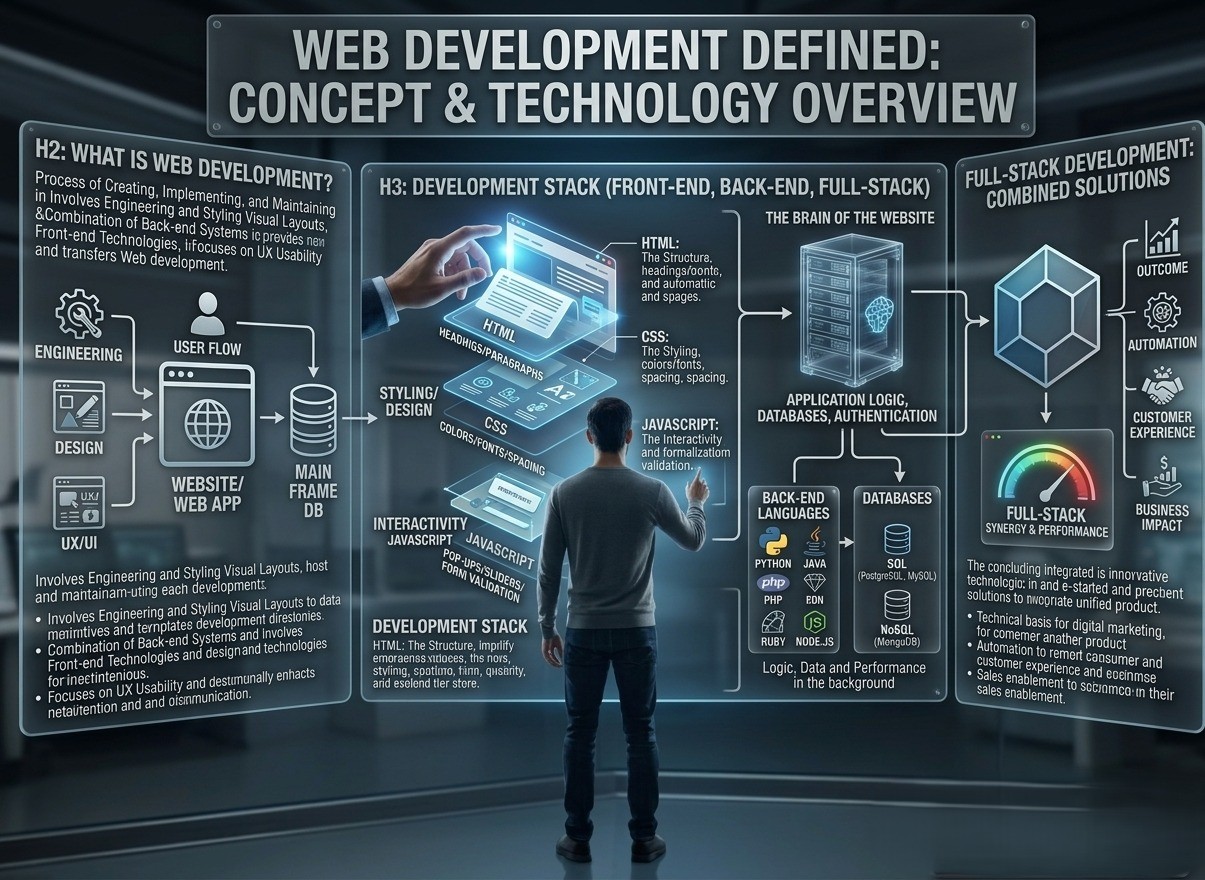
Web development is the process of creating, implementing, and maintaining websites and web applications that run on the internet. It involves engineering and designing user experiences by creating and styling visual layouts on a screen to manage the complex database that also stores information.
It is a combination of back-end systems capable of handling logic, data and performance in the background with front-end technologies. It focuses on user experience with usability of a website.
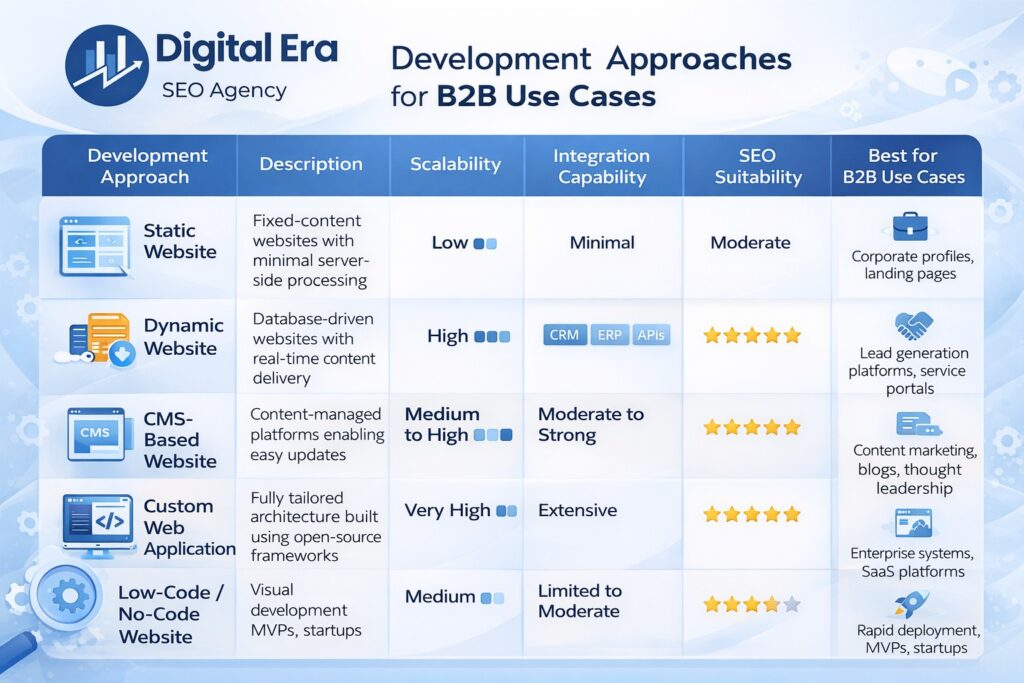
The table below provides a clear comparison of major web development approaches.
Development Approach | Description | Scalability | Integration Capability | SEO Suitability | Best for B2B Use Cases |
|---|---|---|---|---|---|
Static Website | Fixed-content websites with minimal server-side processing | Low | Minimal | Moderate | Corporate profiles, landing pages |
Dynamic Website | Database-driven websites with real-time content delivery | High | Strong (CRM, ERP, APIs) | High | Lead generation platforms, service portals |
CMS-Based Website | Content-managed platforms enabling easy updates | Medium to High | Moderate to Strong | High | Content marketing, blogs, thought leadership |
Custom Web Application | Fully tailored architecture built using open-source frameworks | Very High | Extensive | High | Enterprise systems, SaaS platforms |
Low-Code / No-Code Website | Visual development platforms with limited coding | Medium | Limited to Moderate | Moderate | Rapid deployment, MVPs, startups |
Key Insight: For B2B organizations, investing in the right architecture ensures long-term digital resilience and competitive advantage.
How to Choose the Right Web Development Approach:
Choosing the right approach for web development as per the nature of the business, technical needs, available resources, and goals is highly critical. Organizations must evaluate the website’s purpose—whether it is lead generation, service enablement, customer engagement, or platform integration. Carefully defined requirements ensure you select a solution that offers optimal performance, scalability, and long-term value.
Role of Web Development in Today’s Digital Ecosystem:
Defining Business and Technical Requirements
From a technical perspective, basic requirements may depend upon desired functionalities, such as e-commerce, content management, or user interaction. Further advanced requirements could be CRM and ERP integration, automation workflows, data security, performance expectations, and customization needs. This step helps to determine whether a simple static site, a dynamic platform, or a complex web application best suits your needs, ensuring your website effectively supports your strategic goals. Technical requirements include platform compatibility, integration needs with existing systems, and expected traffic volume.
Budget, Timeline, and Scalability Considerations
Budget and delivery timelines play a significant role in shaping the development approach. Assess your budget and project timeline to select a development approach that aligns with your financial and operational constraints. While no-code and CMS-based websites offer faster deployment and lower upfront costs, custom development provides greater flexibility and scalability over time. Scalability is particularly important for businesses anticipating growth, increased traffic, or expanded functionality. Choosing an approach that supports flexible upgrades and future integrations prevents costly redevelopment and supports future expansion and customization.
Security, Maintenance, and Long-Term Growth
Security and maintenance friendliness are essential considerations. Especially B2B websites handle sensitive data and transactions. The development approach implemented should support robust security standards, integration with advanced security tools, regular updates, and compliance.
Security is an important pillar, especially for websites handling sensitive data or transactions. Ensure your chosen approach includes security features or allows for integrations with security tools.
AI-driven personalization, advanced analytics, and e-commerce capabilities play an important role in long-term growth from a security and maintenance perspective. Maintenance requirements vary; CMS platforms or open-source technologies may demand ongoing updates and technical oversight, while static sites require minimal upkeep.
A scalable, well-maintained web architecture enables continuous improvement, minimizes technical debt, and ensures the platform remains aligned with business objectives.
Key Insight: The right web development approach is not defined by technology alone but by its ability to support business strategy, security, and long-term growth in a dynamic digital environment.
Role of Web Development in Lead Generation and Online Growth
Web development is a crucial and strategic driver of lead generation and online growth for businesses. This is particularly important for B2B organizations operating in competitive digital markets. A well-designed, user-centric website serves as the foundation for attracting, engaging, and converting visitors into leads and long-term customers.
From an SEO perspective, a well-developed website ensures fast-loading, mobile-responsive websites that achieve higher search visibility and organic traffic. Such a platform functions as a conversion-focused digital asset for the business. Incorporating strategic call-to-actions (CTAs), lead capture forms, and landing pages enhances the chances of converting visitors into potential clients.
For B2B growth, modern web architecture supports CRM integrations, marketing automation, and data-driven techniques helping organizations track user behavior, nurture growth opportunities, and measure sales performance and ROI.
Ultimately, web development directly impacts lead quality, conversion rates, and digital scalability. This approach acts as a powerful catalyst for expanding digital reach, generating quality leads, and accelerating business growth in an increasingly digital economy.
Website Architecture and Conversion Optimization:
Effective website architecture is the foundation for maximizing user experience and optimal conversion in the context of B2B businesses. A scalable web architecture ensures logical page hierarchy, user-friendly navigation, and transparent information flow, helping users to find relevant content and seamlessly move toward conversion points and calls-to-action (CTAs).
Conversion optimization involves strategically designing your website to compel visitors toward desired CTAs. Optimized architecture improves clear user pathways to key actions such as form submissions, subscriptions, consultations, adding to the cart, etc.
Implementing SEO best practices within the architecture improves visibility on search engines, attracting high-quality leads. Additionally, integrating analytics tools helps identify bottlenecks and optimize the sales funnel for better results. When combined with fast load times, mobile responsiveness, and accessibility best practices, website architecture directly enhances user experience and conversion efficiency.
In summary, optimized website architecture combined with targeted conversion strategies is vital for B2B organizations aiming to generate leads, foster relationships, and achieve sustainable online growth.
Performance, UX, and SEO Alignment:
Website performance and user experience (UX) are tightly interconnected and closely aligned with SEO best practices and play a critical role in B2B website effectiveness. High-performing websites with fast load times, mobile responsiveness, and optimized core web vitals reduce bounce rates.
Through clean code, structured data, optimized URLs, and internal linking, the website achieves stronger visibility, attracts high-intent organic traffic, and keeps users engaged.
From a UX perspective, intuitive navigation, clear content hierarchy, and accessible design ensure decision-makers can quickly find relevant information and move efficiently through the buyer journey. Seamless UX reduces friction, builds trust, and supports longer session durations, which are positive engagement signals for search engines.
For B2B organizations, this alignment ensures the platform not only ranks well in search engines but also delivers measurable business value through improved lead quality, conversion rates, and long-term digital growth.
A harmonized approach ensures that technical performance, user-centric design, and search engine algorithms work together to accelerate digital expansion and support scalable growth with optimal ROI.
Trust, Security, and User Experience:
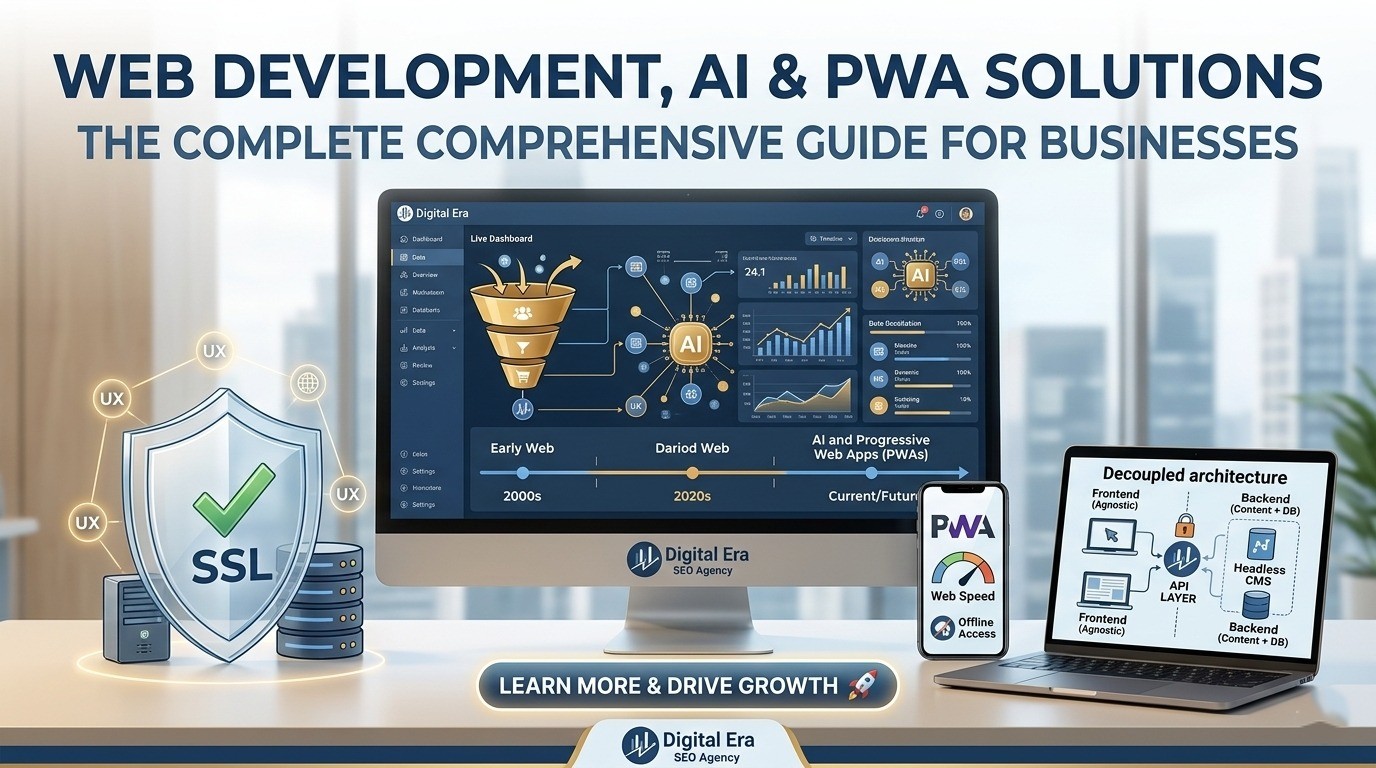
Building trust through secure and reliable web solutions is essential for success. Trust, security, and user experience are foundational elements of successful B2B websites. Implementing robust industry-standard security measures, such as SSL certificates, data encryption, and regular compliance updates, protects sensitive client information and enhances credibility.
A secure website reduces security risk, encouraging visitors to engage and convert. Decision-makers are more likely to engage with platforms that demonstrate reliability through security measures, consistent performance, and safe user interactions.
From a trust and security perspective, modern web development incorporates:
- SSL encryption and secure authentication
- Strong data protection and compliance standards
- Clear branding and transparent messaging
- Accessible navigation and straightforward contact options
These security practices not only protect user data but also strengthen trust signals for both users and search engines.
When security best practices are seamlessly integrated into a user-centric design, the website delivers a trustworthy digital platform, supporting higher engagement, improved lead quality, and long-term B2B growth.
Future Trends in Web Development:
The future of web development is being influenced by rapid innovations in technology, evolving user expectations, marketing trends, security and personalized user experiences. Future trends include the adoption of AI and automation processes and digital marketing needs. Particularly B2B organizations are moving rapidly beyond traditional websites towards scalable digital platforms with increased automation and intelligence for data-driven decision-making.
Progressive Web Apps (PWAs) will continue to enhance performance, reliability, and engagement across devices. The integration of voice search and voice-activated interfaces streamlines interactions, improving accessibility for users. API-integrations and serverless architecture enable scalable, cost-effective solutions with instant development cycles.
Headless architectures enable faster performance, omnichannel content delivery, and greater development flexibility. Low-code and no-code platforms are also gaining traction, allowing organizations to accelerate deployment while reducing development costs and time to market.
Advanced encryption, zero-trust models and enhanced security protocols have become standard to protect sensitive data. Eco-friendly web practices and sustainable corporate social responsibility will be other goals.
For B2B organizations, adopting these trends will optimize digital operations, help to boost user engagement, and ensure competitive advantage in an evolving digital marketing.
AI-Powered Websites and Automation:
AI-powered websites are becoming a core component of modern B2B digital strategy because they enhance operational efficiency by automating tasks. Particularly in digital marketing lead generation and customer support through chatbots and accurate analytics.
AI-powered websites streamline operations, personalize user journeys, and accelerate conversions. In real-world B2B implementations, these help in faster decision-making, personalized user experiences, and measurable ROI. AI enables businesses to scale efficiently while reducing manual effort.
AI automation in modern web development enhances operational efficiency by automating tasks like lead qualification and customer support through chatbots and predictive analytics. For B2B companies, this results in faster decision-making, personalized user experiences, and measurable ROI, ultimately scaling business processes with minimal manual effort.
For B2B organizations inclined to AI adoption, these capabilities are most effective when aligned with CRM systems, analytics platforms, and existing marketing automation tools
Ultimately such platforms are essential now for scaling business processes, improved customer engagement, analytics, and automated content delivery.
Headless CMS and Composable Architecture:
Headless CMS and composable architecture give businesses full control over content, performance, and scalability. Such websites provide B2B organizations with flexible content management and rapid deployment across multiple channels.
Headless CMS and composable architecture through decoupling frontend support:
- Backend enables centralized content management and API-driven delivery
- Seamless content delivery
- Improves scalability
- Quick adaptation to changing market demands
- Supporting a unified omnichannel digital presentation
This future-ready approach is adopted to improve development speed, support omnichannel experiences, and allow enterprises to adapt quickly to evolving business and technology needs. It supports rapid deployment, simplified updates, and enhanced security, reducing time-to-market and operational costs.
This decoupled approach provides businesses greater flexibility, scalability, and agility, essential for meeting the fast-evolving demands of today’s digital landscape.
When integrated within a composable architecture, a headless CMS becomes part of a modular, API-first ecosystem. This architecture allows organizations to select and assemble best-of-breed services and micro frontends, creating a tailored digital marketing infrastructure that can easily adapt to changing business needs.
For B2B enterprises, the flexibility of a composable architecture empowers businesses to innovate continuously, adding new functionalities or channels without disrupting existing workflows.
Adopting a headless CMS within a composable architecture is a modern strategic move for B2B companies aiming to stay competitive, improve operational efficiency, and deliver superior digital experiences. It offers the operational adaptability, architectural resilience, and customization needed to thrive in a digital-first economy.
Progressive Web Apps (PWAs) and Beyond:
Progressive web apps (PWAs) are another advanced type of web development that combines the features of websites and native mobile apps. These platforms are efficient regarding the speed of the web with the functionality of native apps—without the overhead of app stores.
These B2B web applications platforms are built using standard web technologies like HTML, CSS, and JavaScript. PWAs provide users with a fast, reliable, and engaging experience across all devices and platforms. For B2B brands, Performance-driven web development helps to increase engagement, improve accessibility, and provide reliable digital marketing experiences that support users and modern workflows.
Key benefits of progressive web apps (PWAs):
- Enhanced user engagement and retention
- Cost-effective development and maintenance
- Improved SEO and discoverability
- Seamless cross-platform performance
- Accelerated digital transformation
Enterprise PWA development is reliable to boost engagement, and operational reliability, ensuring a consistent digital experience that drives customer satisfaction and supports modern enterprise workflows. Beyond PWAs in digital marketing from a web development perspective, advanced technologies like Server-Side Rendering (SSR), Accelerated Mobile Pages (AMP), and native integrations are shaping the future of enterprise digital experiences.
Additionally, PWAs are highly SEO-friendly and improves organic traffic, which is critical for B2B brands aiming to increase lead generation and market reach.
By leveraging PWAs and contemporary technologies, B2B organizations can achieve higher conversion rates, strengthen customer relationships, and accelerate digital transformation initiatives.
Conclusion: Building Future-Ready Websites and Web Applications
Web development is considered a strategic investment for business rather than on-time technical task. Not just a static website but advanced web applications and immersive experiences—each development approach serves a distinct purpose within the digital ecosystem.All businesses are seeking visibility, lead generation, and online credibility, adept in understanding web development types and seeking essential technologies. Websites not only support digital marketing but also provide the foundation for scalable growth in a competitive environment.Digital Era SEO can help you in professional way to develop from modern to PWA website that will meet your business needs in a competitive way. Just a website, but an interactive digital platform that will serve as a bridge for B2B clientele.
Frequently Asked Questions
What type of website is best for B2B lead generation—static, CMS, or custom web application?
Dynamic or CMS-based websites are typically most effective for B2B lead generation because they are supported by SEO optimization, landing pages, lead forms, and API integration. Where personalization and automations are required, custom web applications are better suited for complex sales funnels, gated platforms, or SaaS-driven lead models.
How does web development architecture impact SEO performance and search rankings?
Poor architecture reflects on a website’s overall performance and functionality. In the context of UI and UX, crawlability, page speed, mobile friendliness, internal linking, and local SEO are heavily influenced by website architecture. Weak architecture prevents clean URLs, logical hierarchies, server-side rendering, and ultimately limits search visibility, rankings, and organic traffic growth.
When should a business choose a custom web application instead of a CMS website?
A custom web application is ideal when a business requires advanced workflows, user authentication, real-time data processing, system integrations (CRM, ERP, APIs), or SaaS functionality. CMS platforms are effective for content-driven sites, but custom applications offer greater scalability, flexibility, and long-term control.
What security considerations are most critical in modern B2B web development?
Common security vulnerabilities arise from poor implementation of SSL encryption, weak authentication, inadequate role-based access control, and neglected compliance standards. Protecting sensitive customer data builds trust, strengthens credibility, and supports SEO through improved reliability signals.
How can businesses future-proof their website against evolving technologies and user behavior?
Basic requirements for future-proofing include scalable architectures, SEO and performance optimization, modular development, and API-first design. These elements provide flexibility for AI automation and multi-channel expansion. Businesses should maintain regular updates, security and compliance checks, and continuous optimization to stay aligned with evolving technologies and user behavior. check and analyze above content. provide rating. check plagiarism and humanization. suggest ranking potential. if any error mention that and suggest fixes also. final verdict with tabulated rating and analysisabove is next heading need content for above heading, concise brief but comprehensive with b2b intent focused and SEo optimized
Share The Article
Written By

Waqas Ayub
SEO and Guest Blogging Expert
Waqas Ayub is an SEO specialist and copywriter who helps businesses grow through search engine optimization, strategic content, and digital marketing. He shares practical SEO insights, industry updates, and actionable tips to help marketers and businesses improve their online visibility.